Using AI to Analyze Prediction Markets
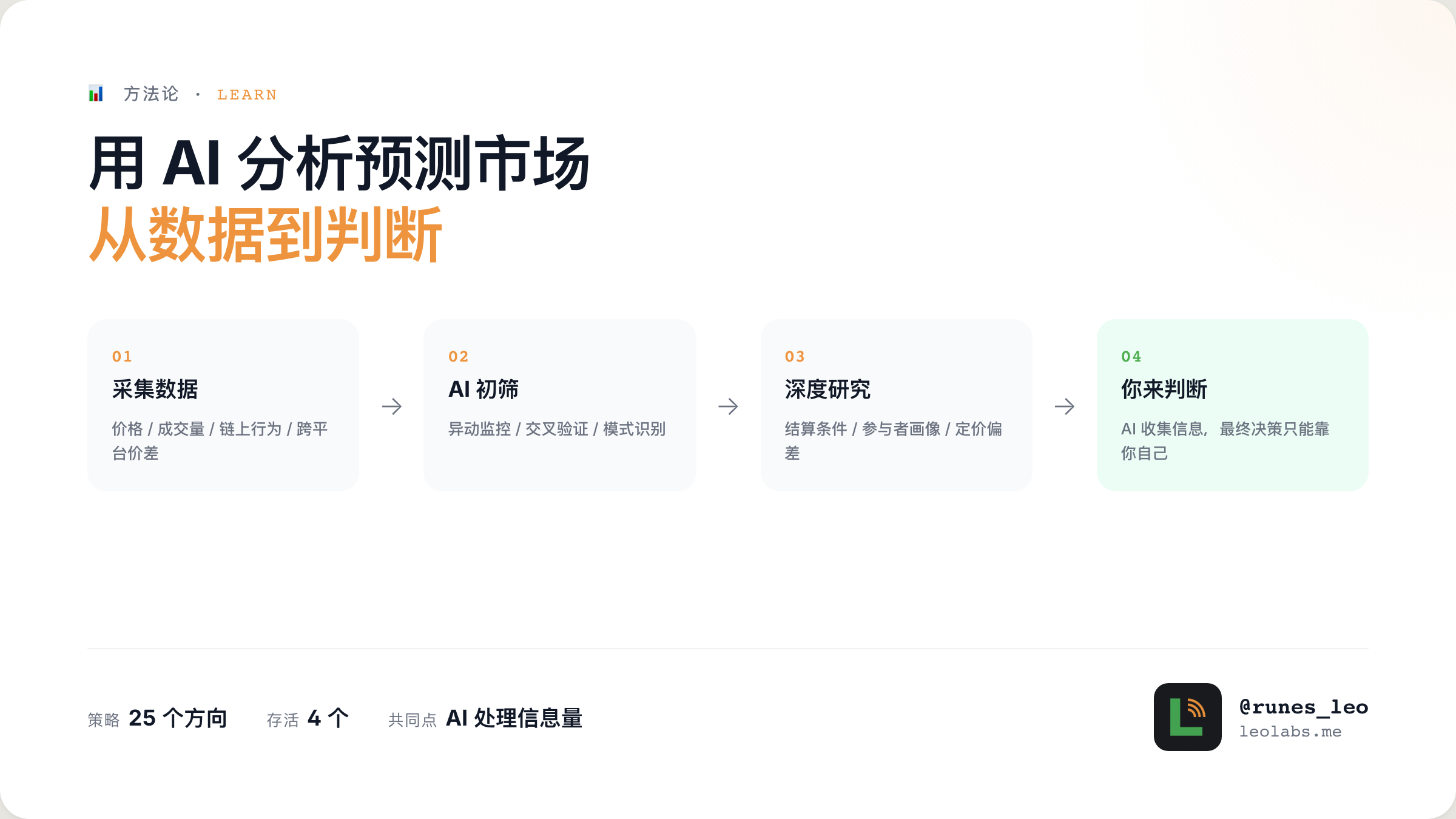
After a year on Polymarket, I've tried 25 different trading angles. Four survived. The survivors shared one trait: AI handled the information volume that my brain couldn't.
This piece covers my methodology — what to look at, why it matters, and where AI fits in. Tooling details come in future posts.
Prediction market data looks nothing like stocks
If you come from equities, prediction markets will feel alien. No candlesticks, no earnings reports.
Here's what actually matters:
Price and volume. Price is the market's consensus probability. Volume tells you how much money backs that consensus. A Yes token at 70 cents with $200 daily volume? That "70% probability" is barely a signal.
Expiry and resolution criteria. Every contract has explicit settlement rules. "Will the Fed cut rates in June?" and "Will the Fed cut rates before 2027?" might look like the same question — but the pricing gap can be 30 cents. Misreading resolution criteria is one of the most common ways to lose money here.
Participant behavior. Who's buying, who's selling, large orders or retail flow, fresh capital or existing positions being reshuffled. All of this is on-chain and fully public on Polymarket. Most people never check.
One more thing that's easy to overlook: cross-platform spreads. The same event can be priced differently on Polymarket and Kalshi. That gap itself is information.
What AI actually does here
Humans make decisions. AI handles information collection and processing.
Concretely:
I built a monitoring system with Claude Code that scans the entire platform daily — price anomalies, new market listings, large trades. I used to spend 30 minutes scrolling through market lists every day. Now I spend 3 minutes reading an auto-generated briefing. That single change freed me from screen-watching.
Then there's cross-referencing. Is a market's pricing reasonable? For something like an election contract, you'd want to check polls, betting odds, news sentiment, and how similar events settled historically. Doing that manually takes hours. AI runs it in minutes.
I've profiled the top 40 addresses on Polymarket's leaderboard. The consistent winners share a remarkably similar pattern: they target mispriced, low-attention contracts. That kind of large-scale pattern recognition doesn't happen by flipping through spreadsheets.
One thing I didn't expect to be this useful: having AI audit resolution criteria. Losses in prediction markets often come not from wrong calls, but from misunderstood rules. I've had Claude break down several contracts' settlement logic and it saved me from the "I was right but the contract didn't agree" trap.
Don't let AI make the call
There's a hard boundary worth stating.
AI can gather information, crunch data, and surface patterns. The buy-or-pass decision is yours alone.
The reason is straightforward: making money in prediction markets requires disagreeing with consensus. AI models are trained on consensus data — their output will roughly match the current market price. The edge you need can only come from your own research in a domain you understand.
My workflow: AI tells me "something's off in this market." I decide what that means.
Getting started
Pick a domain you already know. Prediction markets span politics, sports, tech, weather, crypto — focusing on an area where you have an information edge beats trying to cover everything.
For data, Polymarket exposes market data via public APIs. On-chain transaction records sit on Polygon, fully transparent. Add a news API and you have the raw ingredients.
Start by feeding your domain's market data to Claude and asking it to flag potential mispricings. You don't have to trust every call, but it narrows your focus. From the shortlist, do your own deep research. The final move is always yours.
My stack
- Claude Code — analysis scripts, monitoring, data processing
- Polymarket API + Polygon RPC — market and on-chain data
- Self-hosted Telegram Bot — anomaly alerts
- OpenNews — news feeds
I'll write up each of these individually in upcoming posts.
Sign up through this link to begin trading